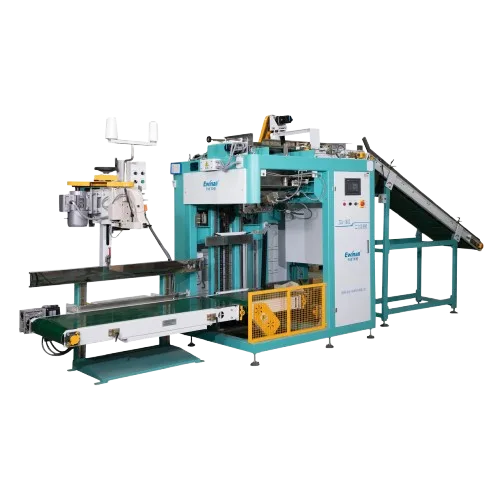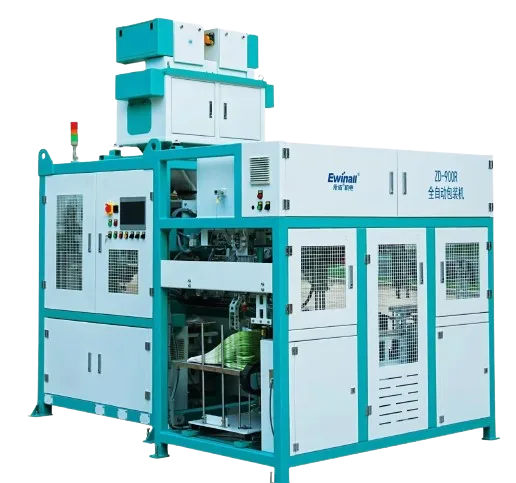

A packaging line earns the label "high-speed" when weighing, filling, sealing, and conveying run as one continuous process instead of a sequence of manual handoffs. For a plant moving from a few hundred packs an hour to 500 or 600, the difference is not a faster conveyor belt. It is a shift in how the whole line is controlled.
From a Single Scale to a Continuous Line
Ecronic's path to automated packaging started with a single component, not a full line. The DCS-50 electronic weighing scale, introduced in 2004, replaced manual scales with something a plant floor could trust for repeat accuracy. Five years later, the high-speed dual-scale DCS-50FB1 pushed that accuracy to higher speeds and earned seven patents along the way.
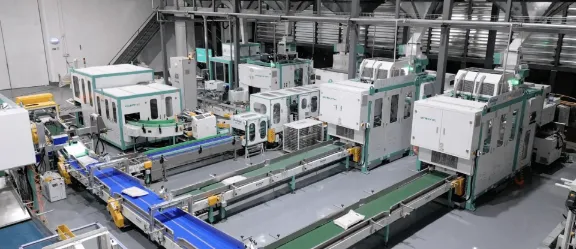
The first fully automated packaging line followed in 2010, built as a working prototype rather than a product on a shelf. It combined bag feeding, weighing, filling, and sealing into a single controlled sequence, the same architecture that Ecronic's automatic lines still use today. In 2012, COFCO Group became the first major customer to run that line in production, and by 2015 an automated rice packaging line built for Yihai Kerry was processing 1,000 tons a day.
The 2010 prototype that became the architecture behind every automatic line Ecronic builds today.
What Actually Makes a Line Fast
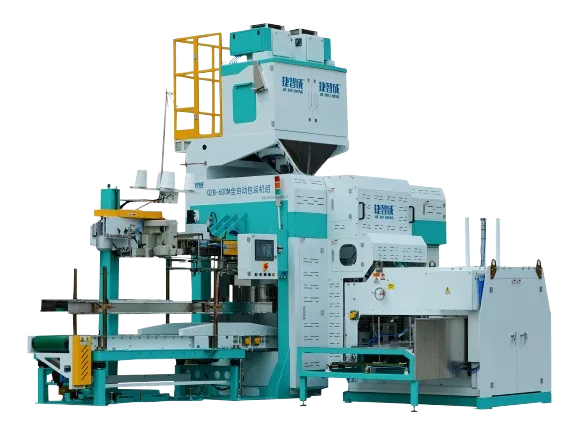
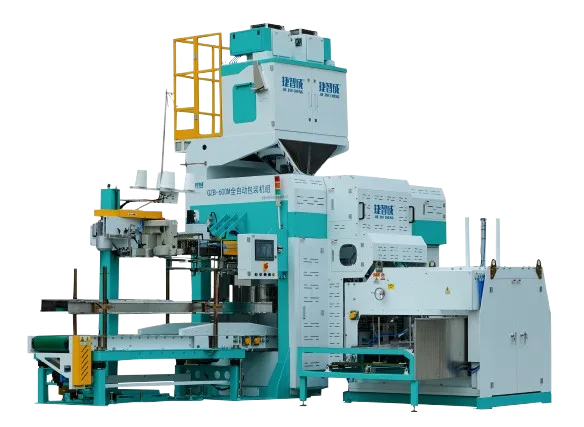
Speed on a packing floor rarely comes from one part running faster. It comes from removing the pauses between steps. On an automatic line such as the QZB-600M2, that means a patented bag feeding and opening system that keeps bags moving without an operator repositioning each one by hand, a three load-cell weighing structure that holds accuracy steady even as speed increases, and a PLC with touch-screen HMI that lets an operator change product formats in minutes instead of shutting the line down. Safety interlocks stop the machine automatically on a fault, which sounds like a small detail until you count how much downtime a single unnoticed jam causes on a manual line.
500-600 packs an hour on a single automatic line - throughput that would take several manual bagging stations to match.
Automation Milestones
| 2004 | The DCS-50 electronic weighing scale is introduced, replacing manual scales on the floor. |
| 2009 | The high-speed dual-scale DCS-50FB1 launches and earns seven patents. |
| 2010 | The first prototype of a fully automated packaging line is completed. |
| 2012 | COFCO Group adopts the fully automated line, the first customer to run it in production. |
| 2015 | A large-scale automated rice packaging line for Yihai Kerry goes live, running 1,000 tons a day. |
| 2019 | Packaging lines reach international customers in Thailand, Vietnam, Indonesia, and Turkey. |
Where the Time Actually Goes on a Manual Line
Most of the delay on a manual packing floor is not in any single motion, it is in the checks between motions: positioning a bag, filling it, stopping to verify the weight, sealing it by hand, then repeating the sequence for the next bag. Each of those checks is necessary on a manual line precisely because nothing upstream is verifying itself. An automatic line folds the check into the process itself, so weighing accuracy and bag handling are enforced by the equipment rather than by an operator's attention, and the line only pauses when it actually needs to.
Deciding If a High-Speed Line Fits Your Floor
Not every operation needs to run at 600 packs an hour, and the right starting point depends on a few practical factors: your target throughput, the bag format you already use, and the power and compressed air supply available on site. A plant packing 25-50 kg open woven bags is a straightforward fit for a line like the QZB-600M2; heavier formats or unusual bag dimensions are worth checking against equipment specifications before committing to a layout.
If you are weighing up whether an automatic line makes sense for your production volume, our team can walk through the numbers with you and, where it helps, point to a comparable installation from our case studies.